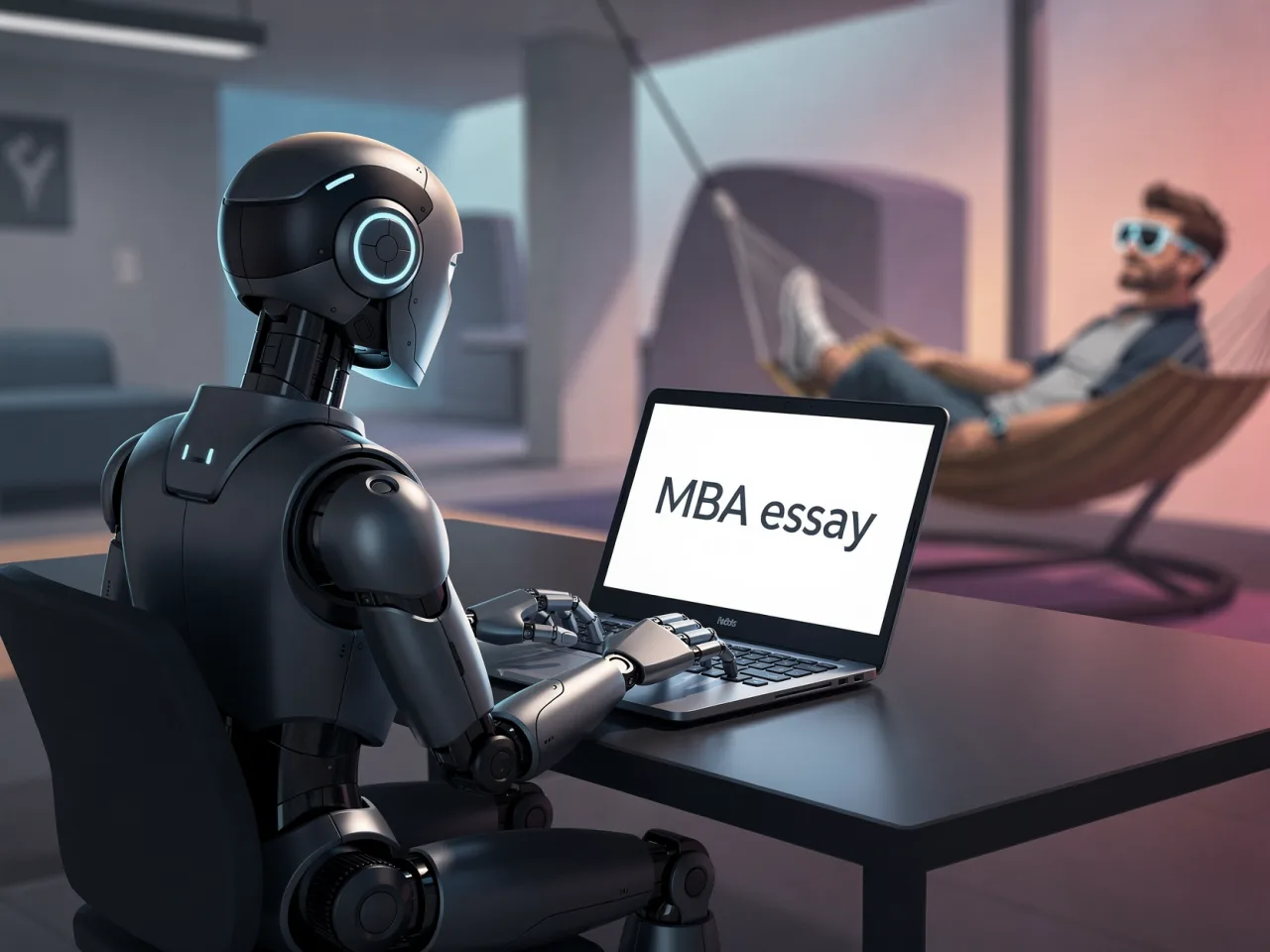
Generative AI (ChatGPT, Anthropic Claude, Gemini) is trained on essays and language. It predicts the next word or sentence it suggests to you based on that training, which makes its suggestions generic. We tested the top models by applying admissions expertise of what an admitted candidate’s essay looks like. We found that these models have an incorrect understanding of an MBA essay: they predict the essay is improved by suggesting terms and phrasing that shove leadership and accomplishments in every essay. This is a misconception of what MBA admissions look for, and AI is making it worse. Well written grammar is generic when it misses showcasing the imperfect aspects of human experiences.
What does a generic MBA essay paragraph look like?
A client wrote this for Harvard Business School’s Leadership-Focused essay, describing how she mentored a student as one example of leadership:
“I have made it a point to be a resource for students navigating the internship process by regularly having coffee chats with freshmen and sophomores and letting university advisors know that I’m available to help. Over multiple conversations with one sophomore, I shared insights into the company and role she was applying for, tips on how to navigate behavioral interviews, and an introduction to the possibilities within various finance roles. I broke down what I wished I had known earlier, from structuring interview responses to making an impact in a new role.”
What does generic AI feedback catch?
I ran this exact paragraph through a plain “give me feedback on this MBA essay passage” prompt, no admissions context attached, to see what a generic pass would flag. It wasn’t nothing:
“First sentence is doing too much… ‘I shared insights… tips… and an introduction to’ is a list-of-three construction… Missing the ‘so what.’ Right now the passage documents generosity and competence but doesn’t say what happened as a result.”
That’s a real edit. The list-of-three flag is correct, one of the tells we teach people to spot. The “so what” flag is directionally right too. Generic AI helped polish the grammar and structure, not the message being delivered to admissions.
What does generic AI miss on an MBA essay?
A general-purpose review doesn’t give you admissions-specific pattern recognition. It hasn’t read hundreds of essays that got candidates into your target school versus rejected. My note, after advising 200+ admits:
“The details of what you shared are good, although you are limiting your description of your contribution to only describing facts without the impact. Recall that moment, the reson why you did it, how you decided to show up the way you did. Then share some of those moments with admissions. From this single leadership example you can show that you do invest in others, without being asked, as well as the ability to use EQ to have an impact.”
What does expert MBA.AI essay feedback catch that AI misses?
MBA.AI exists because I encoded exactly this judgment into it. Here’s what it catches, specific to what HBS’s Leadership-Focused prompt is actually testing:
- Open with a more active, scene-grounded moment rather than a general habit statement. “I have made it a point to be a resource” tells us your intent but doesn’t show the reader who you are in action. A single, specific detail — a question this sophomore asked, or the moment you realized she needed more than interview tips — would pull the reader in immediately and let your mentorship style speak for itself.
- “Over multiple conversations with one sophomore, I shared insights into the company and role…” This sentence carries a lot of weight by stacking three things in a list. Consider trimming one item and using the space to show how you shared — did you walk her through a mock answer? Did you reframe finance as a career she hadn’t considered? The how is where your leadership style lives.
- “What I wished I had known” deserves more room. This is quietly the most compelling phrase in the paragraph — it tells us your mentorship isn’t transactional, it’s reflective, built from your own early uncertainty.
- To strengthen it within a full essay, make sure it connects back to the leadership style you name elsewhere, whether that’s proximity, service, developing others, or something else entirely. Right now it reads as a warm, genuine act of mentorship; the next revision can make it legible as your specific way of leading.
MBA.AI tells you exactly how to fix both a general habit statement with one concrete scene, and use the space that list-of-three wastes to show the specific exchange that reveals your leadership style. Going beyond describing steps is the gap MBA.AI fills.
Why doesn’t generic AI catch this on its own?
Generic AI is trained to sound helpful across every domain at once. It doesn’t catch the specific bar your target program holds you to, because that bar mostly isn’t written down where a model can retrieve it. Admissions officers pattern-match it from hundreds of real admits and real rejections, at a specific school, for a specific kind of prompt.
That’s the gap MBA.AI is built to close. Not “AI is bad at editing,” because it isn’t. Generic AI doesn’t know what makes your essay land at your specific MBA program, and you can’t always tell the difference between a suggestion that sounds smart and one that’s actually going to land with your adcom.
FAQ
How do I know if my MBA essay sounds like AI wrote it? The more content the AI created for you, the higher the risk. This is due to Generic AI’s (ChatGPT, Anthropic Claude, Gemini) training on general essays and not what admissions look for. Second, tells that come from that general training get repeated over and over again. Without a voice sample or expertise layered on top of the model, it will default to these tells, for example, the manufactured emphasis ‘the perfect experience’ or smart remarks.
Can admissions officers tell if I used AI to write my essay? They can tell when an essay is generic and uses predictable language. Adcoms read thousands of essays a cycle and recognize interchangeable phrasing on sight, whether it came from AI or from a human writing what sounds safe. Run the check yourself with our free AI Slop Detector.
Is it OK to use AI to help write my MBA essay? Yes, used as a thought partner rather than a ghostwriter. A generic or broad prompt like ‘improve this essay’ produces generic output. AI sharpened with real admissions expertise catches different, more specific issues than a plain ‘give me feedback’ prompt does.